
Best Home Treadmills in Singapore (2026)
One treadmill on Amazon asks S$5,400 without stating its motor power anywhere on the listing. The Bowflex T9 at S$2,550.60 is the one to buy: a full running belt, 15 percent incline, and a lifetime frame warranty.
As an Amazon Associate, Gyms.sg earns from qualifying purchases. Links here, including to our partner brand OnWhey, may earn us a commission at no extra cost to you.
A treadmill is the one piece of home equipment where the spec sheet routinely lies. "Horsepower" is usually a peak figure the motor can't hold, and one machine on Amazon right now asks S$5,400 without stating any motor power at all. The one to buy is the Bowflex T9. It has the full-size 56 by 152cm belt that lets a tall runner stride out, a 0 to 15 percent motorised incline, and the warranty that tells you the maker believes in it: lifetime on the frame and four years on the motor. After the run you push the deck up, the gas shock catches it, and your floor comes back.
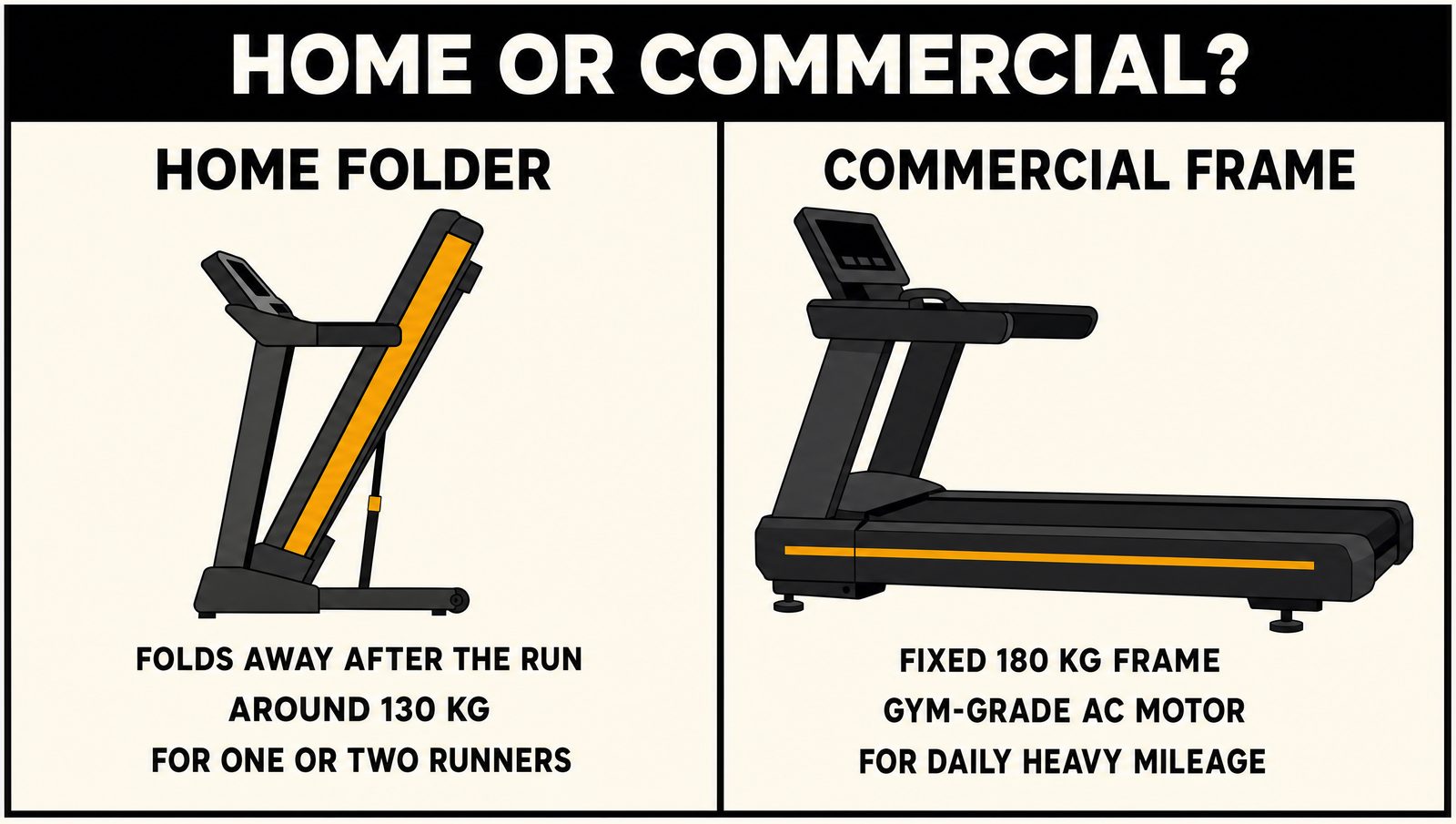
The split that decides your budget: a home folder stores itself between runs, a commercial frame trades all of that for mass and a motor built to run all day.
At around S$2,550 as of July 2026, the T9 is not cheap. But hold it against the alternatives and the money makes sense: it's roughly two years of a mid-range gym membership, it's less than half the price of the commercial Spirit machines below, and unlike the S$370 to S$800 walking pads we covered in our walking pad guide, it's built for actual running at up to 20 km/h, not desk-pace walking.
There's one honest step up. If several people in your home run daily, or you simply want the machine your gym uses, the Spirit CT850+ is a genuine light-commercial treadmill with a gym-grade AC motor and a 205kg user rating. It costs nearly three times as much and never folds, which is exactly why most people should stop at the T9.
Every option at a glance
| Product | Price (SGD) | Motor | Folds | Max user |
|---|---|---|---|---|
| Bowflex T9 | S$2,550.60 | 3.5 HP | Yes | 159kg |
| Spirit CT850+ | S$7,275.60 | 4.0 HP AC | No | 205kg |
| Spirit CT800+ | S$6,614.10 | 3.0 HP AC | No | 205kg |
| PZHANGZVH folding treadmill | S$5,443.53 | Not stated | Yes | Listing conflicts |
Read that last row again: a S$5,443 treadmill whose listing never states its motor power. We'll come back to it, because it's the best lesson on this page about how treadmill listings work.
Bowflex T9: best for most runners
The Bowflex T9 (S$2,550.60) gets the three specs that actually decide a running treadmill right. The belt is 56 by 152cm, the size reviewers recommend once you're over 1.8m or running past 11 km/h, because a short deck forces a choppy stride. The incline is motorised through 15 levels up to 15 percent, so hill work happens at a button, and it means you can train climbs in air-conditioning at noon instead of waiting out the heat. And the Bowflex T9 folds on a gas-assisted hinge with transport wheels, which a fixed commercial frame never will.
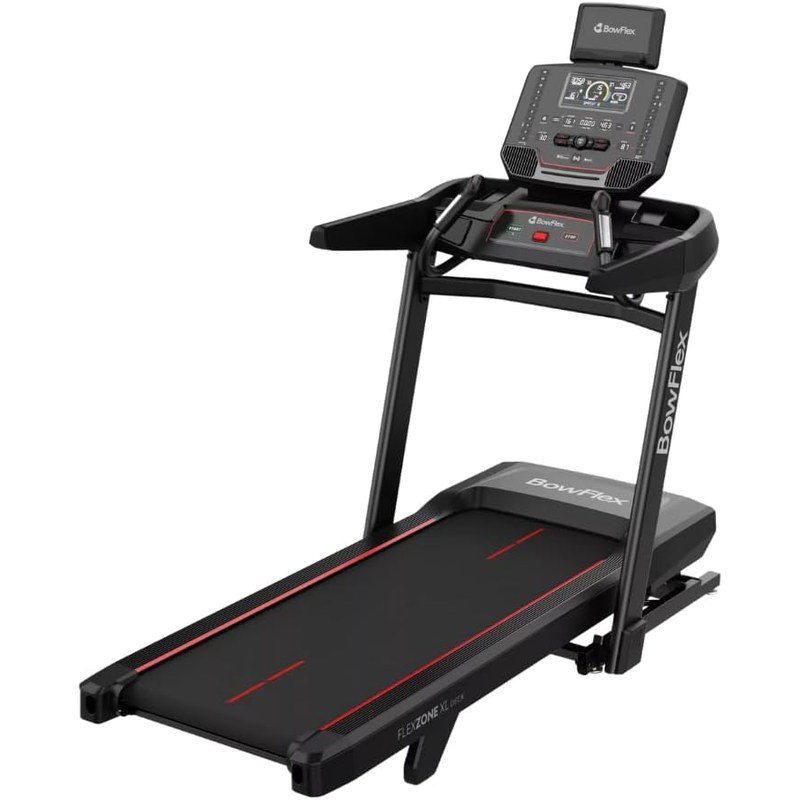
Folds to 123.5cm long on a gas shock; the belt is a full 56 by 152cm. Image from the Amazon listing.
The console is the honest kind. A 7-inch colour LCD, ten built-in programs, and open Bluetooth streaming to Zwift, Kinomap, Peloton's app or JRNY on your own tablet, with no subscription required for any of it. That's a deliberate reversal from the touchscreen-and-subscription Bowflex era, and it aged well: per Treadmill Review Guru's testing, the trade-offs are a tablet holder that lets a phone rattle at running pace, and Bluetooth that pairs either an app or a heart-rate strap, not both at once. Reviewers there also found the deck cushioning firmer than average, which some runners prefer and some don't.
Two things to weigh before you pay. This listing has no local review history yet, so the track record rests on independent US reviews of the same model rather than Amazon buyers, and Bowflex itself was bought out of bankruptcy in 2024 by Johnson Health Tech, the Taiwanese giant behind Matrix and Horizon, which is precisely why the current warranty reads well: lifetime frame, four years motor, two years deck under the local terms. If your budget stops well short of this, a cheaper foldable or a walking pad is the better call than stretching for a used commercial unit.
Spirit CT850+: the gym machine, at the gym price
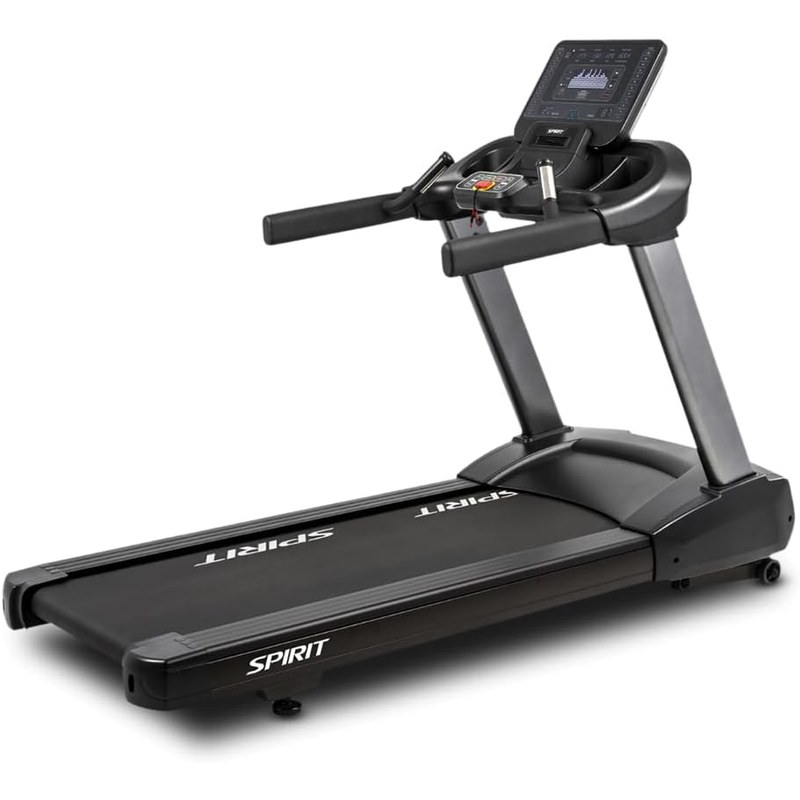
A 180kg fixed frame with a 4.0 HP AC drive motor, the type commercial gyms run all day. Image from the Amazon listing.
The Spirit CT850+ (S$7,275.60) is what the extra S$4,700 over the T9 buys: a 4.0 HP AC drive motor with Grade H insulation, the induction-motor type built for hours of continuous daily use, a 205kg user rating, a 25mm commercial deck, and a one-piece frame that weighs 180kg. Spirit sells this platform to actual gyms, and the belt ships pre-lubricated and rated for thousands of hours. If three people in your household run every day, this is the machine that shrugs at it, and there's something to be said for stepping onto the same deck at home that you'd queue for at the gym.
The costs go past the price. It never folds, so those 216 by 91 centimetres are gone from the room permanently. Delivery up stairs is charged extra on the listing, S$60 for the first storey and S$40 for each one after, and the item is final sale, no returns. The console is multi-window LED rather than a screen, the heart-rate chest strap is sold separately, and under business use the motor warranty drops to one year. Buy it for the drivetrain, not the electronics, and only if daily multi-user mileage is genuinely your situation.
The two we'd skip
The Spirit CT800+ (S$6,614.10) is the CT850+'s little brother: same 205kg rating, same size, same warranty, but a 3.0 HP motor instead of 4.0 for only S$660 less. If you're already spending north of S$6,000 on a fixed commercial frame, paying 10 percent more for a third more motor is the obvious move, and if you're not, the T9 at S$2,550 covers you. There's no budget where the CT800+ is the right answer.
The PZHANGZVH folding treadmill (S$5,443.53) is the trap the intro warned about. The listing describes its motor only as a "premium vacuum motor" with no horsepower or wattage anywhere, its title says 150kg capacity while a bullet in the same listing claims 350lbs, and its top speed is 12 km/h, below every other machine here. The same white-label design is sold in the US under the SereneLife brand for around US$740, roughly a fifth of this asking price. Nothing about it justifies a commercial-tier price tag, and a spec sheet that contradicts itself is the single clearest signal to walk away. One more name you might be looking for: the NordicTrack 1750 has been out of stock on Amazon since at least May 2026, and our NordicTrack review covers where it stood when available.
What actually kills treadmills
Almost never the motor on its own. The belt and deck take every footstrike, and a dry belt is the classic killer: friction heat builds until the deck board's glue fails, and the overloaded motor often goes with it. The fix costs a few dollars and ten minutes, silicone lubricant roughly every 240 to 320 kilometres of use, which for a 25km-a-week runner means about once a quarter. Belts themselves are consumables on a 3 to 5 year clock in regular home use.
This is also why the warranty pages matter more than the console photos. A maker that offers lifetime frame and multi-year motor coverage is betting its own money the machine survives your mileage; a 90-day warranty is telling you the opposite. Electricity, for what it's worth, is a non-issue: at Singapore's current tariff a running hour costs about 21 to 24 cents, so even a daily runner spends less per year powering the machine than on one month of most memberships. Our treadmill buying guide goes deeper on maintenance if you want the full picture.
Or keep using the gym's
Run the numbers before committing S$2,550. A mid-range membership at S$90 to S$110 a month takes more than two years to cost T9 money, the gym services its own belts, and its treadmills sit next to a squat rack and showers. If a good club is near your route, that's a real alternative: Fitness First One Raffles Quay (4.7 stars, 738 Google reviews), Anytime Fitness Bukit Timah Central (4.9, 999 reviews) and Snap Fitness Woods Square (4.8, 648 reviews) all run full cardio floors, and the rest are in our 24-hour gym directory. The home treadmill wins on one thing only, and it's the thing that matters most: the run that happens because the machine was three steps away at 6am. If that's the run you keep missing, buy the machine.
Common questions
What's the best home treadmill for running?
How much treadmill motor do I actually need?
How long do home treadmills last?
Do treadmills use a lot of electricity?
Is a commercial treadmill worth it at home?
Updated July 2026: first published. Prices from Amazon listings; NordicTrack 1750 still out of stock; PZHANGZVH listing flagged for missing motor spec.